18 September 2026 · 9 min read
Why Corporate Wellness Programmes Fail
An investment that isn’t delivering results.
- Written by
- Laura Pérez NaharroClinical Nutritionist & Science Communicator
- Reviewed by
- Carmen Jiménez MedinaMedical Writer & CEO of Medhhionine

Corporate wellness has evolved from a complementary initiative into a strategic priority for many organisations. Today, corporate wellness programmes, including physical activity, stress management, mental health, and nutrition, are widely implemented to improve both health and employee performance.
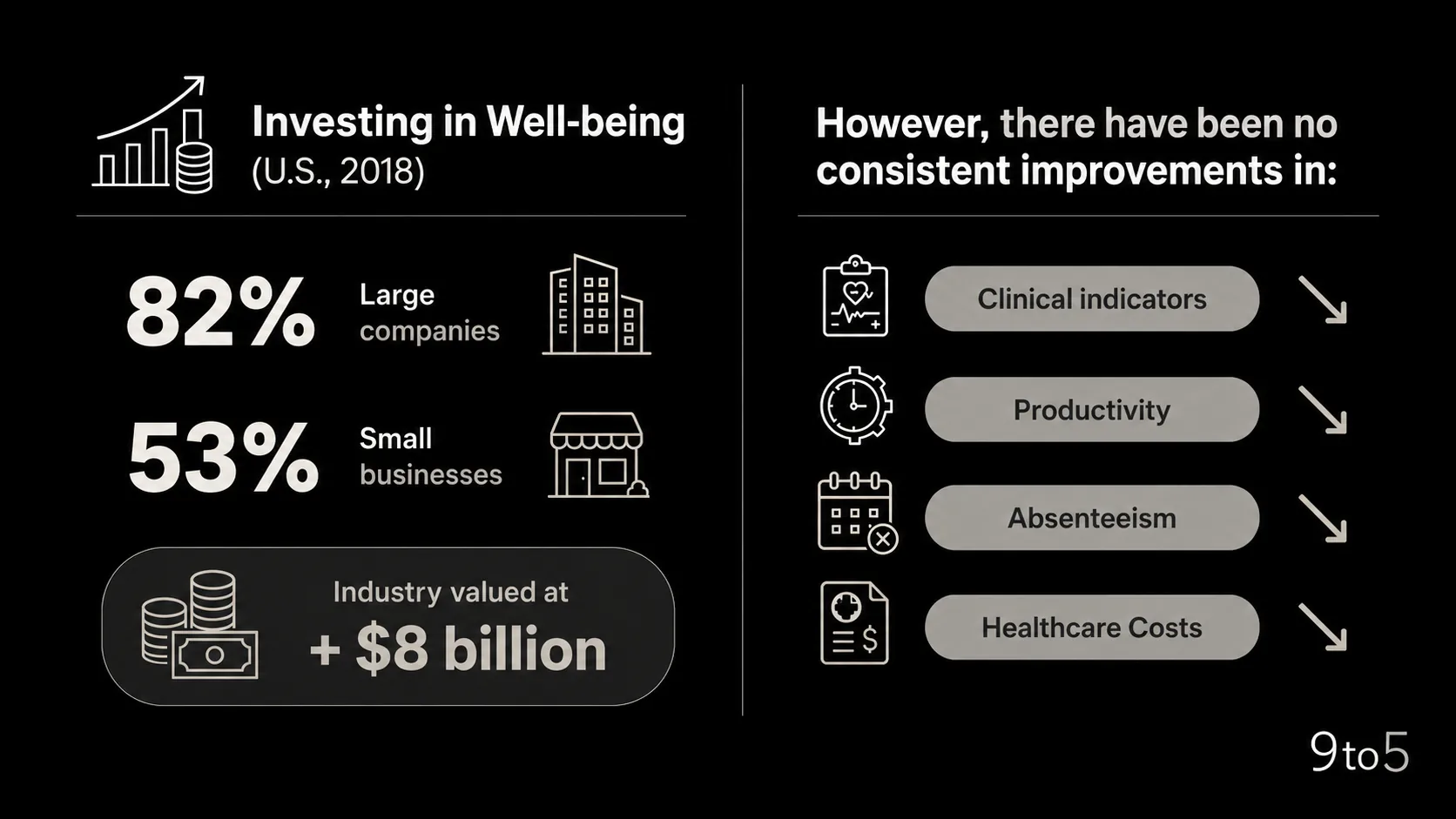
This growth has been substantial. By 2018, 82% of large companies and 53% of small businesses in the United States were already offering corporate wellness programmes, contributing to an industry valued at over $8 billion.
However, this expansion has not translated into consistent improvements in:
- Clinical outcomes
- Workplace productivity
- Absenteeism
- Healthcare costs
A randomised clinical trial published in JAMA found no significant results after 18 months. Participation stayed low: 36%–44%.
So, why do most corporate wellness programmes fail to improve employee performance, and what essential elements are missing?
Modern work is redefining employee performance
To understand the limitations of current corporate wellness programmes, it is essential to examine modern work itself.
Today, employee performance depends largely on cognitive capacity. The workday demands sustained attention, multitasking, continuous decision-making, and constant adaptation. These demands may not generate obvious physical fatigue, but they create significant physiological strain.
As cognitive demands rise, the brain shifts resources, weakening performance. Mental fatigue can occur after 60–90 minutes; brief breaks don’t always help.
Stress further compounds this effect. When activation becomes chronic, it not only impairs employee performance, affecting energy, concentration, and decision-making, but also has long-term consequences for health.
Modern work demands performance while simultaneously disrupting the conditions that make it possible. Corporate wellness programmes are not failing because employees don’t care about their health — they are failing because they are designed outside the reality of work.
The core limitation of corporate wellness programmes: lack of integration into work
If modern work imposes a specific physiological burden, corporate wellness programmes should logically operate within the workday. In practice, most do not.
- Digital programmes
- Health apps
- Gym access
- Workshops
These resources are available but often require extra time, energy, and attention, all of which are often depleted by the work environment.
A meditation app subscription, for example, does little for an employee with back-to-back meetings and no real opportunity to pause or disconnect during the day. Similarly, access to healthy food options has limited impact if the work schedule leaves no time for proper breaks, leading employees to rely on quick, low-quality choices between tasks.
Moreover, these solutions rarely reach those who need them most. Participation tends to be higher among employees who already have healthy habits, while higher-risk individuals engage less. As a result, the impact on employee performance remains limited.
Corporate wellness is typically treated as a supplemental benefit rather than a fundamental redesign of work to support sustained performance.
When a strategy requires extra effort in a context of fatigue and stress, it is unsurprising that only motivated individuals adopt it. This is the core limitation of current corporate wellness programmes: they are optional, not structural.
Employee performance has a biological foundation: energy, stress, and cognition
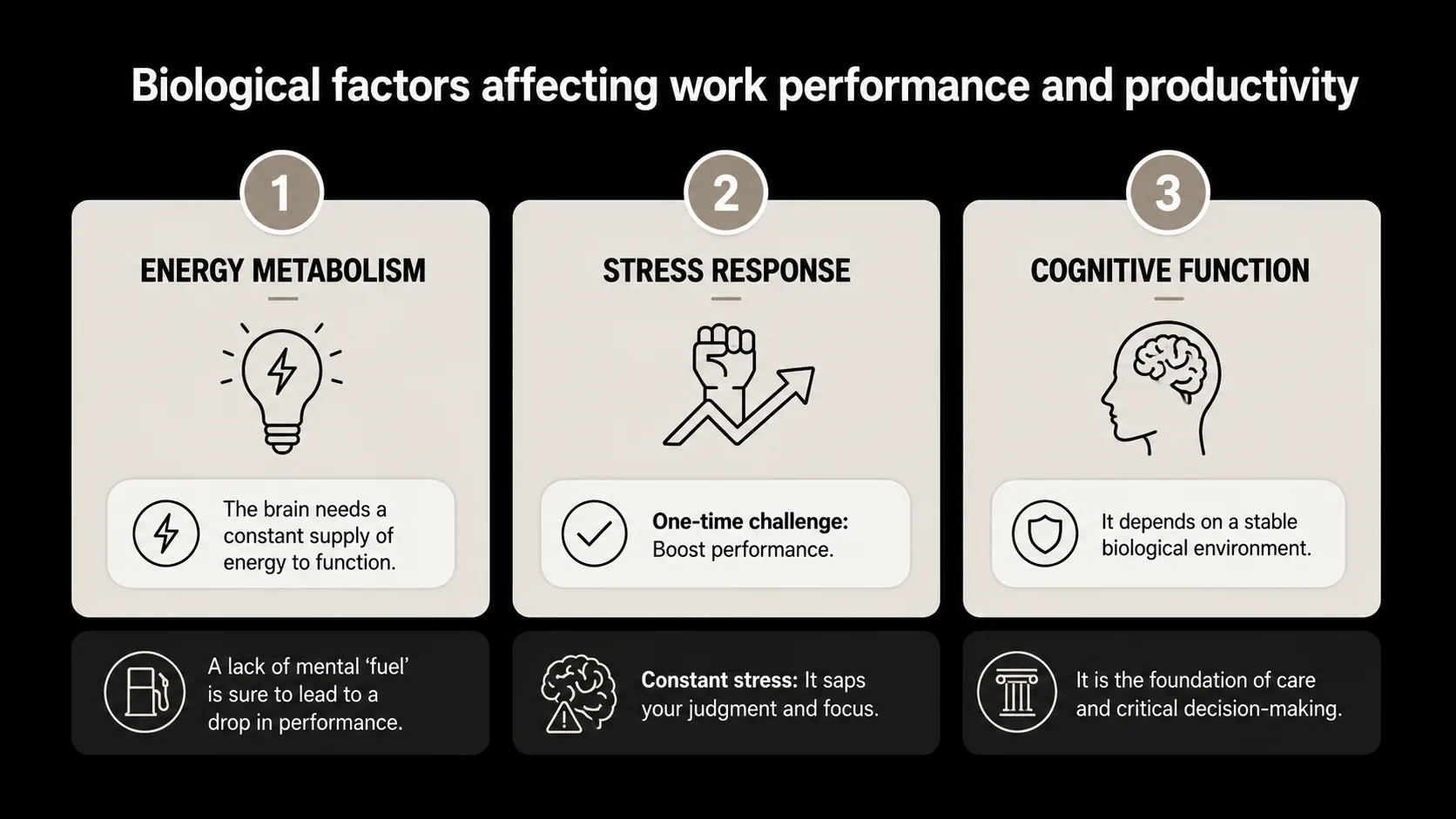
Employee performance and workplace productivity are driven by biological systems — energy, stress, and cognition — that determine the ability to sustain attention, manage effort, and respond to work demands. These systems are directly influenced by underlying factors such as nutrition, which shapes how energy is produced and sustained throughout the day.
- First, energy metabolism. The body must continuously produce energy to sustain cognitive effort. When energy availability declines, fatigue emerges and performance drops, directly affecting energy at work.
- Second, stress response: brief stress helps, but chronic stress harms concentration, decisions, and performance.
- Third, cognitive function, which depends on a stable energy supply to the brain.
These systems are interconnected. When one is disrupted, the others are affected. Low energy reduces focus, while chronic stress impacts both energy availability and mental clarity.
Ultimately, employee performance reflects the balance between these systems. Any corporate wellness programme aiming to improve productivity and address work-related stress must act on these underlying mechanisms, not just on motivation or habits.
Nutrition and productivity: a key driver of employee performance
One of the most overlooked drivers of employee performance is nutrition. If employee performance depends on energy, stress, and cognitive function, then nutrition and productivity are directly linked. Yet nutrition remains one of the least integrated components of most corporate wellness programmes.
- Food directly shapes cognitive performance. Meal composition influences attention, memory, and processing speed, as each macronutrient triggers a different physiological response.
- Metabolic stability becomes a performance variable. Sharp fluctuations in blood glucose lead to reduced concentration, higher fatigue, and lower cognitive efficiency. More stable energy availability supports sustained focus, faster decision-making, and more consistent workplace productivity and performance.
- Meal timing further conditions energy in the workplace. Irregular or poorly distributed intake can lead to energy gaps during periods of peak cognitive demand, directly affecting output.
The business impact is measurable. Research shows that cognitive impairment related to fatigue and low energy has been associated with productivity losses of up to 10–20%, while presenteeism — employees being at work but not fully functioning — can cost organisations 2–3 times more than absenteeism. Even small declines in attention and decision-making can translate into more errors, slower execution, and reduced output at scale.
Integrating nutrition into the work environment has been associated with improvements in energy, mood, and fatigue. However, it is still largely treated as an individual responsibility, limiting its impact. Positioned correctly, nutrition shifts from a health-related benefit to a structural lever for improving employee performance, productivity, and stress management.
If performance is biologically driven, then improving it requires changing the conditions that shape these systems.
From benefits to strategy: the shift corporate wellness programmes need
Current corporate wellness programmes rely too heavily on voluntary employee participation rather than systemic solutions. In environments marked by fatigue, stress, and limited time, this approach has limited impact.
From a business perspective, this often results in low ROI. Work-related stress alone is estimated to cost companies between €2,000 and €3,000 per employee per year, driven by reduced productivity, errors, and inefficiencies.
Structural interventions, by contrast, modify the environment to facilitate behaviour. They reduce friction, increase accessibility, and make healthier choices more likely.
- from voluntary benefits to integrated solutions
- from isolated initiatives to structural models
- from individual responsibility to organisational design
How to design corporate wellness programmes that improve performance
If the problem is design, what should effective corporate wellness programmes look like?
- First, integration into the workday. A wellness programme should not be added to work; it should be part of it, for example through default healthy food environments.
- Second, ease of adoption. The lower the effort required, the higher the adherence.
- Third, scientific grounding. Interventions must act on energy, stress, and cognitive function.
- Finally, measurement. Participation alone is not enough. It is essential to assess the impact on employee performance, workplace productivity, and actual usage.
The future of corporate wellness programmes: performance, health, and work design
Corporate wellness programmes often miss their mark because they focus on participation rather than modifying work environments to address today’s real challenges.
In demanding, stressful, high-turnover environments, optional or isolated efforts have little effect.
The focus is shifting from isolated interventions to the design of the work environment itself, with a reconsideration of schedules, demands, and operational dynamics, while integrating variables that directly influence employee performance.
Within this approach, nutrition and productivity become part of the system. Their effects on energy, concentration, and fatigue are particularly relevant when integrated into the workday.
Corporate wellness is therefore evolving towards models that act on working conditions to improve performance, health, and stress management.
Exploring a new approach to corporate wellness programmes
Corporate wellness is moving towards a model more closely aligned with employee performance and the realities of daily work.
Understanding how nutrition, stress, and energy influence workplace productivity opens new avenues for approaching corporate wellness programmes.
Moving forward requires going beyond traditional initiatives and integrating these factors into the design of work itself. The future of corporate wellness is not about offering more options — it is about redesigning work so that performance becomes sustainable by default.
By focusing on the relationship between nutrition and performance, organisations can begin to create work environments that truly empower employees. Embracing this approach marks not only a shift in strategy but also a commitment to sustainable, high-performance workplaces that adapt to the evolving needs of modern work.
Organisations that want to improve performance should start by redesigning the conditions that sustain it.
References
- Song Z, Baicker K. Effect of a Workplace Wellness Program on Employee Health and Economic Outcomes: A Randomized Clinical Trial. JAMA. 2019;321(15):1491-1501.
- Virtanen M, Lallukka T, Elovainio M, Steptoe A, Kivimäki M. Effectiveness of Workplace Interventions for Health Promotion. The Lancet Public Health. 2025;10(6):e512-e530.
- Meyer SC, Hünefeld L. Challenging Cognitive Demands at Work, Related Working Conditions, and Employee Well-Being. Int J Environ Res Public Health. 2018;15(12):E2911.
- Zhang C, Liu N, Xu D, Yuan W. Effects of Task Duration on Mental Fatigue: A Multimodal Analysis Based on Subjective, Behavioral, and Electrophysiological Measures. Int J Psychophysiol. 2026.
- Brazaitis M, Satas A. Regular Short-Duration Breaks Do Not Prevent Mental Fatigue and Decline in Cognitive Efficiency in Healthy Young Men During an Office-Like Simulated Mental Working Day. Int J Psychophysiol. 2023;188:33-46.
- Bayes A, Tavella G, Parker G. The Biology of Burnout: Causes and Consequences. World J Biol Psychiatry. 2021;22(9):686-698.
- Salvagioni DAJ, Melanda FN, Mesas AE, et al. Physical, Psychological and Occupational Consequences of Job Burnout: A Systematic Review of Prospective Studies. PLoS One. 2017;12(10):e0185781.
- Kruger J, Yore MM, Bauer DR, Kohl HW. Selected Barriers and Incentives for Worksite Health Promotion Services and Policies. Am J Health Promot. 2007;21(5):439-447.
- Stratton E, Jones N, Peters SE, Torous J, Glozier N. Digital mHealth Interventions for Employees: Systematic Review and Meta-Analysis of Their Effects on Workplace Outcomes. J Occup Environ Med. 2021;63(8):e512-e525.
- Sevic A, Hashemi NS, Thørrisen MM, et al. Effectiveness of eHealth Interventions Targeting Employee Health Behaviors: Systematic Review. J Med Internet Res. 2023;25:e38307.
- Muth AK, Park SQ. The Impact of Dietary Macronutrient Intake on Cognitive Function and the Brain. Clin Nutr. 2021;40(6):3999-4010.
- Jones EK, Sünram-Lea SI, Wesnes KA. Acute Ingestion of Different Macronutrients Differentially Enhances Aspects of Memory and Attention in Healthy Young Adults. Biol Psychol. 2012;89(2):477-486.
- Sünram-Lea SI, Owen L. The Impact of Diet-Based Glycaemic Response and Glucose Regulation on Cognition: Evidence Across the Lifespan. Proc Nutr Soc. 2017;76(4):466-477.
- Verhulst CEM, Fabricius TW, Nefs G, et al. Consistent Effects of Hypoglycemia on Cognitive Function in People With or Without Diabetes. Diabetes Care. 2022;45(9):2103-2110.
- Brikou D, Dimopoulou MA, Drouka A, et al. Eating Frequency, Timing, and Duration in Relation to Cognitive Performance and Alzheimer Disease Biomarkers in Adults. J Nutr. 2024;154(7):2167-2175.
 Developed and produced in Spain